When I die, let the Bioware development team lower me into my grave so they can let me down one last time.
I clocked about 60 hours into Dragon Age: The Veilguard and finally finished the game, achieving the “best” ending. I knew something was wrong at the 5 hour mark. I started grieving around the 15 hour mark. I stopped playing at the 20 hour mark and reluctantly picked the controller back up after hearing that the ending mission was good.
It was just alright, and it didn’t make up for the disjointed opening and the lagging mid game and the underdeveloped companions.
I didn’t have high hopes for this game since the lead writer left the studio in 2016 and the fourth installment in the Dragon Age series was canceled multiple times in its 10 years of non-consecutive development. To top it off, Bioware laid off Mary Kirby, one of the project’s veterans, in 2023. That left Trick Weekes as the sole veteran, and I don’t like Weekes’s writing.
Personal preference, not to disparage Weekes, but I’ll see something I love in game and proceed to hear the most baffling interpretation of that interaction from the original writer. I’ve never seen an author who I disagree with more about their character’s interiority, or the world they exist in. I don’t think I have ever seen a Weekes tweet about their characters or the setting that didn’t make me concerned for future installments.
For example, Weekes tweeted that Mother Giselle of Dragon Age Inquisition simply didn’t buy that elves were helpless victims of oppression by her organization.
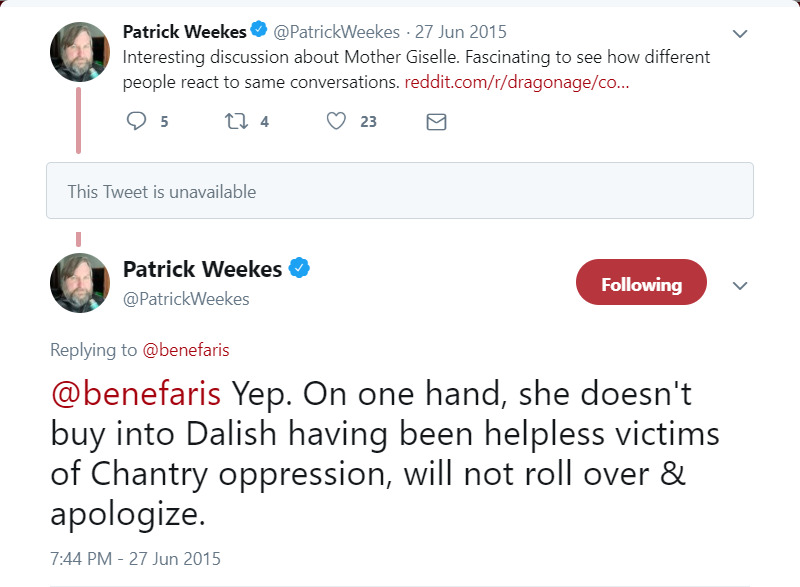
(Rereading this as an adult with more understanding that Twitter was always a terrible medium to express opinions, I could read this more charitably as “She’s old, stubborn, and indoctrinated, and she’s never going to apologize” but a lot of Inquisition’s writing, if you haven’t played the previous games, seems to nod towards elves just failing to pull themselves up by their bootstraps enough. So I find it inconsistent with previous worldbuilding and this remains my biggest criticism of Inquisition today. I’ll leave this up as I consider it a yellow flag of what was to come.)
Dragon Age elves, who live in ghettos called alienages and aren’t allowed to carry weapons in human cities and were enslaved. If you have never played the other games, or read any of the books, or the codex entries in Inquisition, it is absolutely possible to believe that elves are just whining and pining for a long gone era they’ll never get back. Origins and Dragon Age 2 don’t shy away from showing you that, even if you aren’t sympathetic to the elves, their current situation is objectively dogwater. (In Ferelden, literally so!)
Some fans and writers have critiqued this portrayal for being insensitive due to parallels to real world ethnic and cultural groups, which, no matter your feelings on the subject, is a harder topic to get around in 2024 than it was in 2013 when Inquisition came out. Veilguard gets around this issue by simply erasing all of the hardship that elves previously experienced, relegating it to a few scattered codex entries that you may or may not even find. Which was the weakest possible way to address the crapsack world that Dragon Age: Origins and Dragon Age 2 presented.
The earlier Dragon Age games, in fairness, have aged poorly in some respects. Not every player is happy to simulate being the target of a pogrom, or an attempted assault, even if you do get the satisfaction of a bloody rampage through the halls of your would-be assailant with nothing but a borrowed sword and whatever armor you can scrape together. (I am referring to the City Elf origin, which you can play yourself or watch a recording of here.)
Regardless of whether or not these elements would have been a dealbreaker for some players, or if they would have been handled well, I still think that completely erasing them was the wrong way to go. This game wants to be the Dragon Age: Awakening to Dragon Age: Inquisition, but you can’t have that while completely sanitizing the setting.
In Inquisition and Origins, bigotry, stubbornness, and selfishness pose greater obstacles to stopping the extinction events than blighted monsters. But in Veilguard, suddenly Tevinter is totally down to help if not for those pesky Venatori (nothing to do with the slaving mage empire that practices human sacrifice behind closed doors, no siree), the Wardens are happy to help except for the First Warden (who is also happy to help after you talk to him like, twice), and your companions are happy to help (but they all have personal issues that are distracting them from fighting the Elven Gods, Elgar’nan and Ghilanain). Every single faction presented is on board with minimal objection.
There’s no bigotry, no cultural traditions, no self-serving magisters preventing you from getting the resources you need, it’s just wave after wave of faceless monsters and mobsters. And that’s OK…but it’s the least interesting possible interpretation of the Dragon Age setting, which is why I’m still here after 10 years.
But at least I can expect a Bioware game to give me memorable characters and fun companion quests, right? I never liked Mass Effect quite as much as I liked Dragon Age, but the characters were loveable and intriguing. Surely I could expect that from Veilguard, right? Well, wrong.
With the exception of Solas, who is quite enjoyable and true to form, this game fails to build any intrigue or character. Solas is the only character who gets any meaningful or interesting development, and it’s also undercut by your characters sitting around a table and carefully explaining to you what you just learned about him, as the audience is presumed to have not been paying attention.
I would normally stop and say that the art direction was beautiful as always, but honestly, the polish on the gameplay and the art direction is tertiary. These are not games that anyone plays for the beautiful graphics and cutting edge gameplay. We play it for the character-driven storytelling and the reactive worldstates.
Dragon Age: Origins, when I first played it, hooked me like no other game has ever done. I played through every origin. I played evil characters, I played goody-two-shoes, I snarked at everyone and anyone, and I tried the romance routes for every single option. I read all the codex entries. The only thing I didn’t do was recruit Shale, because I didn’t have the DLC the first time I played. And Origins was the first game that had me really thinking about my characters, who they were, how they fit into the world, years before I discovered DnD and became insufferable in a more social hobby.
And now, Dragon Age has left me, and most of the writers who shaped it, behind. It has decided that roleplaying isn’t important, choices aren’t important, who Rook is isn’t important, and our old playthroughs aren’t important. The best ending (or, rather, the hardest outcome to get) involves your character standing back while the actual main characters talk things out. No, that’s not an exaggeration, you can watch it right here.
My fix-it fanfic where the Inquisitor is the main character is gonna be amazing, but message received. This game isn’t for the people who held out hope for 10 years that Dragon Age would get a satisfying conclusion, and I’m not even sure it’s for new fans because I don’t know how you would even understand what was happening if you didn’t play the previous games. But whoever it’s for, it’s not for me.
So maybe this is less about Dragon Age leaving me behind and more about me leaving Dragon Age behind. I still adore the old games, but I won’t be buying any new games in the series. The writing staff have been ship-of-thesseused anyway. Instead I’ll be putting my money towards new games and books. (Stray Gods, a project one of the original writers of Dragon Age: Origins worked on, was a better purchase if only because it was novel and interesting.)
 Miscellennyous
Leave a comment